
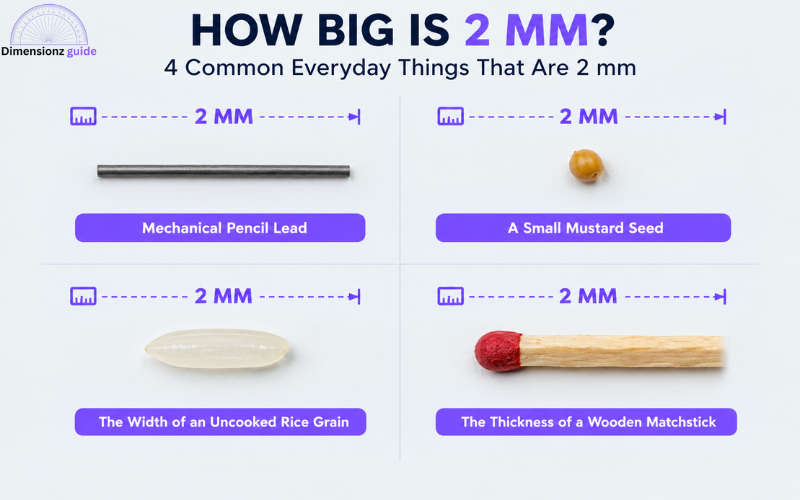
How big is 2 mm? Two millimeters is a very small measurement equal to 0.2 centimeters, approximately 0.079 inches, or about one-thirteenth of an inch. It is difficult to estimate this size by looking at an object because 2 mm is smaller than most everyday items. However, you can understand it by comparing it with familiar things such as mechanical pencil lead, a mustard seed, a grain of rice, and a small screw. These comparisons make it easier to visualize how big 2 mm really is without using a ruler.
How Big Is 2 mm?
2 millimeters equals 0.2 centimeters, or approximately 0.079 inches.
2 mm in Other Units
How to Visualize 2 mm Without a Ruler
Visualizing 2 mm can be challenging because the measurement is quite small. Most people find it easier to compare a tiny measurement with something they can hold, inspect, or recognize from daily life.
For example, a mechanical pencil that accepts 2 mm lead provides a direct reference because the lead diameter is specified by its size. You can also examine a small seed or the thickness of a thin craft material to develop a better sense of the measurement.
Remember that these comparisons are approximate. Seeds, screws, paper, and craft supplies vary by brand, design, and manufacturing process. If you need an exact measurement for a repair, craft project, or technical task, use a ruler with millimeter markings or a suitable measuring tool.
Related Post: 9 Common Everyday Things That Are About 1 mm Long
8 Common Everyday Things That Are About 2 mm
Several familiar objects have a dimension close to 2 mm. Some are useful for understanding width or diameter, while others help you visualize thickness. The following examples use different everyday items so you can compare this measurement from several angles.
1. Mechanical Pencil Lead
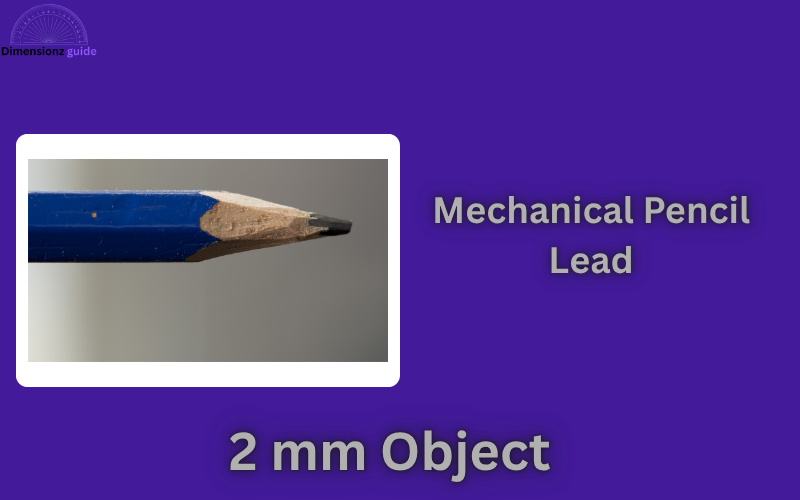
A 2 mm mechanical pencil lead is one of the most direct examples of this measurement. Unlike ordinary thin mechanical pencil leads, which commonly measure 0.5 mm or 0.7 mm, this thicker type has a diameter of 2 mm. That makes it a useful reference when you want to see what two millimeters looks like in real life.
You may find 2 mm lead in certain drafting pencils, art pencils, and clutch pencils used for drawing or sketching. When you look at the exposed lead from the side, its thickness gives you a practical idea of the size. The lead is still narrow enough to appear small, but it is noticeably thicker than the fine lead used in many everyday mechanical pencils.
This comparison is especially helpful for students, artists, and people who regularly use drawing tools. If you already have a pencil designed for 2 mm lead, you can use it as a reference without needing to imagine the measurement from scratch. Just remember that the example refers to the lead’s diameter, not its exposed length.
2. A Small Mustard Seed
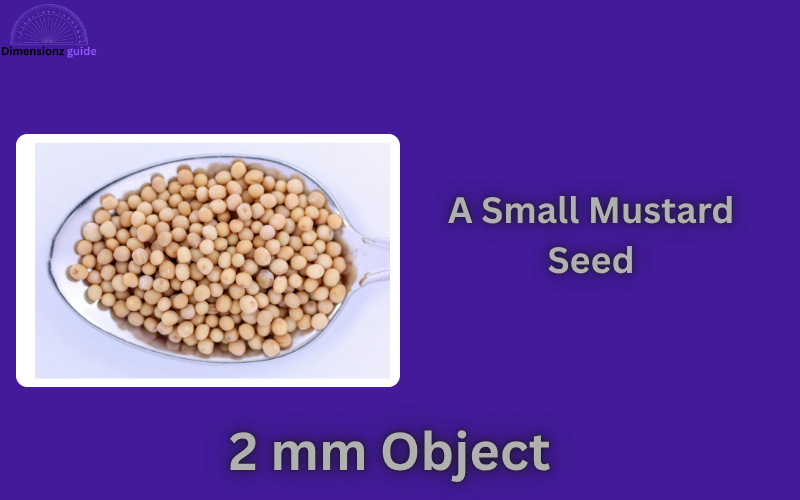
A small mustard seed can provide another useful way to picture a measurement close to 2 mm. Depending on the variety, mustard seeds are often only a few millimeters across, and some are close to this size. Their small, rounded shape makes them easier to compare with other tiny objects.
Mustard seeds are commonly found in kitchens, particularly in households where they are used in seasoning, pickling, and cooking. If you have a container of mustard seeds, place one on a flat surface and examine its width. You may notice that it is much smaller than a typical pea or bean, yet it is still visible to the naked eye.
The exact size depends on the seed variety, so not every mustard seed will measure 2 mm. Some may be smaller, while others may be slightly larger. Even so, a small mustard seed is a helpful everyday comparison because it gives you a real example of the scale involved.
When using this example, focus on the seed’s diameter rather than its height or the amount of space occupied by several seeds together. This distinction matters because a tiny object’s width can be close to 2 mm even when its other dimensions are different.
3. The Width of an Uncooked Rice Grain

An uncooked rice grain is another familiar object that can help you understand a measurement of approximately 2 mm. Rice grains vary considerably in length and width, but many are only a few millimeters wide. Some grains have a width close to 2 mm, depending on the type of rice and its shape.
Rice is easy to find in most kitchens, which makes it a convenient reference. Take a single uncooked grain and look at its broadest part. You will notice that the grain is much longer than it is wide. Its width is the dimension that matters for this comparison, not its full length.
Long-grain rice, short-grain rice, and other varieties have different shapes. A slender grain may be narrower than 2 mm, while a broader grain may be close to or slightly above this measurement. Therefore, a rice grain should be treated as an approximate visual comparison rather than an exact measuring tool.
This example is useful because it shows how a measurement can describe only one part of an object. Although an individual grain may be several millimeters long, its width can be much closer to 2 mm. Understanding this difference helps you make better comparisons when estimating small dimensions.
4. The Thickness of a Wooden Matchstick

A traditional wooden matchstick can help you visualize a thickness around 2 mm. Many ordinary matchsticks have a narrow wooden body that measures a few millimeters across, although the dimensions vary between products. Some are close to 2 mm in width, making them a useful everyday reference.
You can find matchsticks in household cupboards, emergency kits, camping supplies, or boxes kept for lighting candles. The wooden section is thin enough to hold between your fingers but sturdy enough to remain rigid during normal use. Looking at its cross-section can help you understand how small a two-millimeter dimension is.
It is important to distinguish the wooden body from the match head. The head is usually wider and has a different shape, so it is not the best part to use for comparison. Focus on the narrow wooden shaft when estimating the measurement.
Not every matchstick has the same thickness. Some are designed for particular uses and may be noticeably wider or thinner. However, an ordinary narrow matchstick provides a familiar reference for understanding a dimension measured in just a few millimeters.
5. A Thin Craft Foam Sheet
Thin craft foam is another practical way to picture a thickness close to 2 mm. Craft foam is used for school projects, decorations, handmade cards, simple models, and other creative activities. It is available in different thicknesses, and some sheets are manufactured at approximately 2 mm.
Unlike a seed or pencil lead, this example helps you understand thickness across a flat surface. Hold a sheet by its edge and look at the narrow strip along the side. Although the sheet may cover a large area, its thickness can be very small compared with its length and width.
Craft foam is often soft and flexible, so it may compress slightly when squeezed between your fingers. Pressing it firmly can make the material appear thinner than it is when resting naturally. For a more accurate visual comparison, inspect the edge without squeezing the sheet.
The thickness also depends on the type of foam and the manufacturer’s specifications. Some sheets are thinner than 2 mm, while others are considerably thicker. If the packaging identifies the sheet as 2 mm thick, it can provide a particularly clear example of this measurement.
This comparison is useful for people who enjoy crafts because it connects millimeters with a material they may already use at home or school.
6. A Small 2 mm Screw
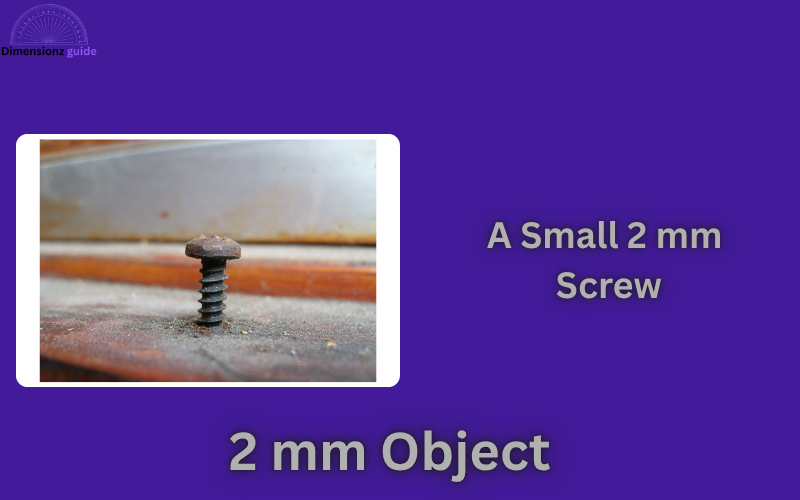
A small screw with a nominal diameter of 2 mm is a useful example of how this measurement appears in hardware. Tiny screws are used in certain electronic devices, small household fittings, models, and precision equipment. Their dimensions vary, but a screw specified as M2 generally has a nominal external thread diameter of approximately 2 mm.
You might encounter small screws when assembling a miniature model, repairing a suitable device, or working with small mechanical parts. When viewed beside an ordinary household screw, an M2 screw looks noticeably narrower. Its small diameter makes it suitable for applications where larger fasteners would take up too much space.
For this comparison, the important measurement is the screw’s outside thread diameter, not the length of the screw or the width of its head. The head may be wider than 2 mm, and the threaded portion has ridges that can make the measurement appear slightly different depending on the viewing angle.
Screws come in many sizes, so you should not assume that every small screw measures 2 mm. Check the product specifications if you need a reliable reference. A screw identified as M2, however, offers a practical way to connect the measurement to a real hardware component.
7. A Stack of About 20 Sheets of Paper
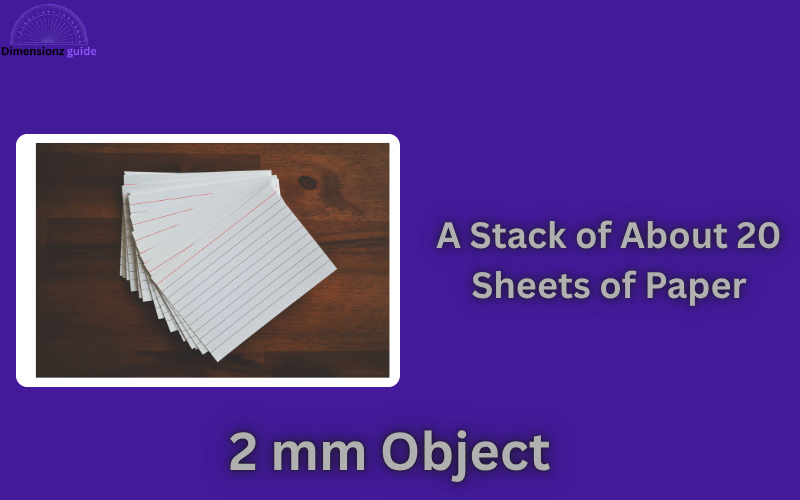
A small stack of ordinary paper can help you understand how a 2 mm thickness builds up from much thinner layers. A typical sheet of office paper is around 0.1 mm thick, although the exact thickness depends on its weight, coating, and material. Under that approximation, about 20 sheets placed together may form a stack roughly 2 mm thick.
You can try this comparison with printer paper, notebook paper, or another relatively thin type of paper. Align the edges carefully and examine the stack from the side. Instead of looking at one sheet, which is extremely thin, you are observing several layers that combine to form a more visible thickness.
This example demonstrates how small measurements accumulate. A single sheet might be difficult to compare with a millimeter marking, but a stack of many sheets creates a thicker edge that is easier to inspect. It also helps explain why thickness measurements are important when calculating how much space a group of materials will occupy.
The result will not always be exactly 2 mm. Paper varies in thickness, and the sheets may compress slightly when pressed together. The comparison is best used as an estimate rather than a substitute for a precise measurement.
8. A Thick Guitar Pick
A thick guitar pick can provide another useful reference for understanding a measurement close to 2 mm. Guitar picks are available in a wide range of thicknesses, from very thin flexible picks to much thicker picks designed for particular playing styles. Some models are approximately 2 mm thick or slightly thicker.
If you have a guitar pick at home, look at its edge rather than its broad, flat face. The edge reveals the pick’s thickness, which is the relevant dimension for this comparison. A pick that is 2 mm thick may feel relatively substantial compared with a thin pick used for strumming.
Guitar picks are made from different materials, including plastic and other synthetic materials. Their shape, flexibility, and edge design can influence how thick they look and feel. A tapered pick may also be thicker in one area than another, so it is important to check the specified thickness when accuracy matters.
Not every guitar pick measures 2 mm. Many are thinner, and some specialty picks are thicker. However, a pick labeled around 2 mm provides a useful example of a flat object whose thickness is close to this small measurement.
How Big Is 2 mm Compared With Other Measurements?
Comparing 2 mm with other units makes the measurement easier to understand. Millimeters are commonly used for small objects because centimeters and meters can be less convenient when describing tiny dimensions.
| Measurement unit | Equivalent to 2 mm |
| Millimeters | 2 mm |
| Centimeters | 0.2 cm |
| Inches | 0.0787 inches |
| Meters | 0.002 m |
| Micrometers | 2,000 µm |
The inch conversion is particularly useful if you normally use inches instead of metric units. Since 2 mm is less than 0.1 inch, it is a very small fraction of an inch. On a ruler marked in inches, it may be difficult to estimate accurately without a fine scale.
The centimeter conversion is also straightforward: ten millimeters make one centimeter, so two millimeters equal one-fifth of a centimeter. This is why millimeters are often preferred for describing the thickness of thin materials, small fasteners, and precision components.
Why Understanding 2 mm Is Useful
Knowing what 2 mm looks like can be helpful in many everyday situations. You might need to compare the thickness of a material, choose the correct small screw, understand a product specification, or check whether a component will fit into a narrow opening.
In arts and crafts, a difference of just a few millimeters can affect how pieces fit together. A foam sheet, for example, may need to be a particular thickness for a project. Understanding the approximate size helps you interpret product descriptions and decide whether a material is likely to suit your needs.
In household repairs, small fasteners often have measurements listed in millimeters. Recognizing that an M2 screw has a nominal diameter of 2 mm can make hardware descriptions easier to understand. Still, the diameter alone does not tell you the screw’s length, thread pitch, or head dimensions, so you should check all relevant specifications before buying a replacement.
This measurement can also matter when selecting precision parts, designing small models, or following technical instructions. In these situations, estimating by sight is useful for an initial comparison, but accurate measurement is important whenever parts must fit correctly.
Common Mistakes When Estimating 2 mm
One common mistake is confusing an object’s length with its width or thickness. A rice grain, for example, can be much longer than 2 mm while its width may be close to that measurement. Always identify which dimension you are comparing.
Another mistake is assuming that every example has an exact size. Natural objects such as seeds and rice grains vary in shape and dimensions. Manufactured objects also differ depending on their design and intended use. A matchstick or guitar pick should therefore be treated as a general reference unless its dimensions have been verified.
Perspective can also affect how small objects appear. When an item is viewed from an angle, its thickness may look greater or smaller than it really is. Placing the object on a flat surface and looking directly at the relevant edge can make the comparison easier.
Finally, avoid relying on eyesight when accuracy is important. If you are selecting a screw, checking a narrow gap, or measuring a material for a project, use a suitable measuring tool. A visual comparison is useful for understanding the scale, but it cannot guarantee an exact result.
If you find this helpful and want more free guides like this then here we have more for you:
- 9 Common Everyday Things That Are About 1 mm Long
- 9 Common Everyday Things That Are About 28 Feet Long
- 10 Common Everyday Things That Are About 27 Feet Long
- 11 Common Everyday Things That Are About 26 Feet Long
- 9 Common Everyday Things That Are About 25 Feet Long
FAQs
Is 2 mm considered small?
Yes, 2 mm is a very small measurement. It equals 0.2 cm and is less than one-tenth of an inch. It is useful for describing thin materials, small components, and the width or thickness of tiny objects.
How many inches is 2 mm?
Two millimeters is approximately 0.0787 inches. Rounded for everyday use, you can think of it as about 0.08 inches, although this rounded figure is not suitable for precision work.
Is 2 mm the same as 0.2 cm?
Yes. Since one centimeter equals 10 millimeters, 2 mm is equal to 0.2 cm. Both measurements describe exactly the same length.
What everyday object is about 2 mm thick?
A 2 mm mechanical pencil lead has a diameter of exactly 2 mm when it is made to that specification. A craft foam sheet or thick guitar pick may also be around 2 mm thick, depending on the product.
Can I measure 2 mm without a ruler?
You can estimate 2 mm by comparing it with familiar objects, such as 2 mm pencil lead or a small screw with a nominal 2 mm diameter. However, these comparisons are not reliable enough for tasks requiring precise measurements. A ruler with millimeter markings or a caliper is better for accuracy.
Is 2 mm bigger than 1 mm?
Yes. Two millimeters is twice the length of one millimeter. Although the difference may look small, it can matter when working with thin materials or small mechanical components.
Related Post: 8 Common Everyday Things That Are About 30 Feet Long
Conclusion
Two millimeters is a tiny measurement equal to 0.2 centimeters or approximately 0.079 inches. You can visualize it by looking at 2 mm mechanical pencil lead, a small mustard seed, the width of an uncooked rice grain, a wooden matchstick, or other objects with a similar dimension.
The most important thing is to compare the correct part of each object. Width, diameter, thickness, and length are different measurements, even when they describe the same item. Everyday comparisons can help you develop a better sense of scale, but a proper measuring tool is the best choice when precision matters.
