
Key Takeaways for Southern Maryland Homeowners
- Stump grinding removes the visible portion of a stump below ground level, making the area easier to mow, landscape, and use.
- Full stump removal can be appropriate when a project requires major root removal, excavation, construction, or extensive grading.
- Wet ground, narrow access, mature trees, waterfront conditions, and uneven terrain can affect stump-grinding plans across Southern Maryland.
- Homeowners should discuss cleanup, chip handling, grinding depth, access, and the planned use of the area before work begins.
- Properties within Charles County’s Chesapeake Bay Critical Area may require additional planning before certain tree work starts.
A leftover stump can turn an otherwise useful Southern Maryland yard into an obstacle course for mowers, children, guests, and future landscaping plans. Whether the stump sits beside a driveway in Waldorf, along a wooded lot in La Plata, or near a garden in Mechanicsville, professional stump grinding in Charles County, MD can help restore a smoother, more functional outdoor space.
Empire Tree Services evaluates each property individually because stump work is rarely a one-size-fits-all task. Soil moisture, gate width, slopes, underground features, nearby fences, and the homeowner’s plans for the space all affect the safest and most practical approach.
Why Stump Grinding Matters in Southern Maryland
Southern Maryland includes a mix of established neighborhoods, farms, wooded acreage, waterfront homes, and growing residential communities. That variety creates different challenges after a tree is removed. A large hardwood stump on a rural Charles County lot may require equipment planning that differs greatly from a small backyard stump surrounded by a patio, fence, shed, or garden bed.
Stumps are more than an appearance concern. They can interrupt mowing patterns, create a low-profile trip hazard, block a new fence line, and prevent homeowners from turning a cleared area into lawn, planting space, or a play area. Some stumps can also produce new shoots, depending on the tree species and condition of the remaining root system.
For larger overgrown areas, homeowners may also consider forestry mulching services when they need to manage brush, saplings, or dense vegetation beyond a single stump. This approach can be useful when a property owner is preparing an unused portion of a lot for better access or a more manageable landscape.
Stump Grinding Versus Full Stump Removal
Stump grinding and full stump removal solve related but different problems. The best choice depends on what will happen in the area after the work is complete.
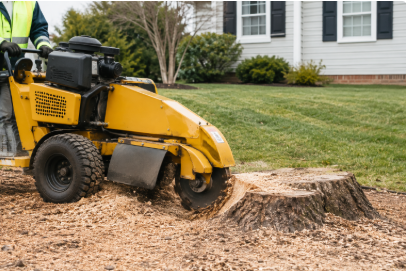
- Stump grinding: A grinding machine reduces the stump below the surrounding grade. This is often a practical option for restoring lawn areas, creating planting beds, reducing mowing obstacles, and improving the appearance of a yard with less surface disruption.
- Full stump removal: This process involves extracting more of the stump and root mass. It can create a larger disturbed area, but it may be the better fit when the location is planned for a foundation, utility installation, hardscape project, drainage work, or major excavation.
- Aftercare: Grinding produces wood chips and leaves roots below ground to decay over time. Homeowners should decide whether chips will remain on site, be removed, or be replaced with clean soil to support grass or new landscaping.
Empire Tree Services can review stump size, root flare, property access, nearby structures, and the intended use of the space before recommending an approach. A clear on-site assessment helps avoid selecting a service that does not match the homeowner’s next project.
What a Stump Grinding Assessment Should Cover
A useful stump-grinding assessment begins with more than a stump measurement. The crew should understand where the stump is located and what surrounds it. A backyard stump behind a narrow gate may require a different machine or access plan than one located beside an open driveway.
- Review the location: Identify the number of stumps, their approximate diameters, the property address, and the desired timeline.
- Check access: Consider gates, slopes, soft ground, landscaping, driveways, patios, fences, and structures near the work area.
- Discuss buried features: Homeowners should disclose irrigation components, septic systems, invisible pet fences, drainage pipes, utility lines, and any known underground structures.
- Set the intended depth: The right grinding depth can depend on whether the area will become lawn, a garden bed, a walkway, or a construction site.
- Confirm cleanup: The written scope should make clear how chips, debris, soil replacement, and final site cleanup will be handled.
Local Conditions That Can Affect the Work
Southern Maryland weather and property conditions can shape both scheduling and site protection. Ground that has absorbed heavy rain may be softer, and crews may need to plan equipment movement carefully to limit damage to lawns. Uneven grades, wooded edges, and tight suburban lots also require a thoughtful approach rather than rushing equipment into place.
Southern Maryland’s landscape adds its own considerations to stump work. The region sits on a peninsula between the Patuxent and Potomac Rivers, so many properties are shaped by low-lying ground, seasonal drainage paths, and tree communities of oak, hickory, tulip poplar, and loblolly pine. Clay-rich soils in parts of Charles, Calvert, and St. Mary’s Counties can hold water after storms, which affects how heavily equipment can travel and how quickly disturbed ground settles. Humid summers also encourage fast regrowth of grasses and brush around freshly ground stumps. Farm properties and rural lots may have old fence lines, buried wire, or former outbuilding footings that were never mapped, making a careful site walk especially valuable before grinding begins. Neighbors in towns like Waldorf, La Plata, and Mechanicsville often share mature tree canopies, so timing work around nesting seasons and local wildlife activity can also be part of a thoughtful plan. Because many Southern Maryland yards transition between woodland and open lawn, the cleared area may also need topsoil, seed, or mulch once the stump is reduced.
Waterfront and near-water properties deserve additional attention. Charles County explains that the Chesapeake Bay Critical Area generally extends 1,000 feet inland from tidal waters and adjacent tidal wetlands, and that tree and shrub removal within the Critical Area requires authorization before work begins. Stump grinding after prior tree removal may present a different scope than removing a standing tree, but homeowners should still ask about site-specific requirements when work could affect protected areas or planned restoration.
Why Licensing and Clear Expectations Matter
Tree and stump work involves powerful equipment, changing ground conditions, and property-specific risks. Homeowners should ask for a defined scope of work that identifies the stump locations, access limitations, planned grinding depth, debris handling, and cleanup expectations. It is also reasonable to ask how lawns, hardscape, fences, and nearby plantings will be protected.
Maryland homeowners can use the state’s Licensed Tree Expert search when evaluating tree-care providers. The Maryland Department of Natural Resources states that tree-care professionals practicing in the state must obtain a license. Empire Tree Services states that its team is licensed, bonded, and insured, and it provides stump grinding alongside tree removal, pruning, emergency service, storm cleanup, land clearing, and commercial tree care.
Preparing for an Empire Tree Services Appointment
Homeowners can help make an estimate and service visit more efficient by clearing movable items from the area before the crew arrives. Move hoses, outdoor furniture, toys, planters, decorations, and vehicles away from the stump zone. If photos are available, sharing them in advance can help communicate access restrictions and the stump’s location.
It is also helpful to explain what comes next for the area. A homeowner planning grass restoration may need a different finish than someone preparing for a patio, shed, vegetable garden, or new tree planting. That conversation allows the work plan to focus on the final result, not simply the removal of visible wood.
Requesting Stump Grinding in Charles County and Nearby Communities
When requesting service, provide the property location, the number of stumps, approximate sizes, photos when possible, and any access concerns. Mention whether the stump is near a fence, driveway, utility feature, septic area, retaining wall, or structure. A site-specific estimate is more useful than relying on a universal price because each Southern Maryland property has different access and restoration needs.
Empire Tree Services | 29816 Adams Rd, Mechanicsville, MD 20659, United States | (240) 585-1152 | https://localtreeman.com/. Map directions are available through Empire Tree Services on Google Maps. Property owners planning a visit or arranging a service request can also read about the Mechanicsville area, where the office is located.
Frequently Asked Questions
Can a stump be ground near a fence or driveway?
Often, yes, but the available space and the location of nearby structures determine which equipment and work plan are appropriate. An on-site review is the best way to identify limitations.
What happens to the wood chips after grinding?
Chips may be left on site for rough mulch, removed, or managed with soil restoration depending on the agreed scope of work and the homeowner’s plans for the area.
Is stump grinding always better than full removal?
No. Grinding is commonly suitable for lawn restoration and general cleanup, while full removal may be preferable when roots interfere with excavation, utilities, construction, or major grading.
Read More: Acoustic Architecture: Designing Home Spaces for Peace, Silence, and Clarity