
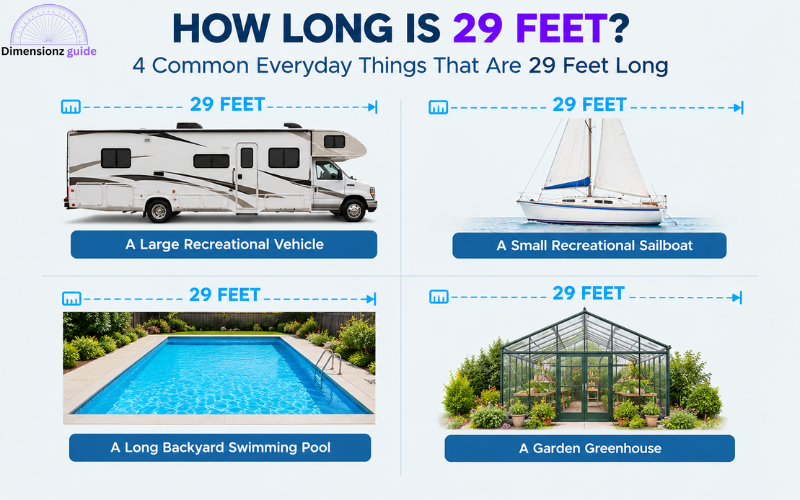
How long is 29 feet? 29 feet is equal to 348 inches, 8.84 meters, or approximately 8.84 meters long. This length is almost as long as three average-sized cars parked bumper to bumper. Although 29 feet can be difficult to imagine using numbers alone, comparing it with familiar objects and structures makes the measurement easier to understand. From recreational vehicles and boats to garden structures and outdoor equipment, several everyday items can help you visualize a length of 29 feet.
In this guide, you will learn how long 29 feet is in different units and explore 10 examples that can help you picture this distance. These comparisons are useful when planning outdoor spaces, estimating dimensions, measuring large objects, or simply understanding how much space 29 feet covers.
How Long Is 29 Feet?
29 feet equals 348 inches or 8.8392 meters.
How Long Is 29 Feet?
29 feet is a measurement of length that equals 348 inches or approximately 8.84 meters. It is a little shorter than 30 feet and can cover a substantial portion of a driveway, garden, or outdoor recreational area.
Here are the main conversions for 29 feet:
| Measurement Unit | Equivalent Length |
|---|---|
| Feet | 29 feet |
| Inches | 348 inches |
| Yards | 9.67 yards |
| Meters | 8.84 meters |
| Centimeters | 883.92 cm |
| Millimeters | 8,839.2 mm |
A length of 29 feet is useful to understand when comparing large objects or estimating distances without a measuring tape. Keep in mind that the examples in this article are approximate comparisons. Actual dimensions vary by model, design, and manufacturer.
What Does 29 Feet Look Like?
A length of 29 feet is about 8.84 meters, making it considerably longer than most household rooms and furniture. Imagine walking from one end of a long recreational vehicle to the other, or looking across a large section of an outdoor recreation area. These comparisons give you a better sense of the distance.
Another simple way to visualize 29 feet is to divide it into smaller sections. For example, it contains four sections of 7 feet 3 inches each. You could also picture a line that stretches nearly 30 feet across a driveway or backyard.
Because people often find metric measurements easier to picture in some situations, remembering that 29 feet is approximately 8.84 meters can also be helpful. This is close to the length of a long room or a substantial outdoor structure.
Related Post: 9 Common Everyday Things That Are About 28 Feet Long
10 Common Everyday Things That Are About 29 Feet Long
Several large objects and outdoor structures can help you visualize a length of 29 feet. The following examples focus on familiar items found in residential areas, recreational spaces, gardens, and construction settings. Their dimensions are approximate, so use a tape measure or product specifications when an exact length matters.
1. A Large Recreational Vehicle
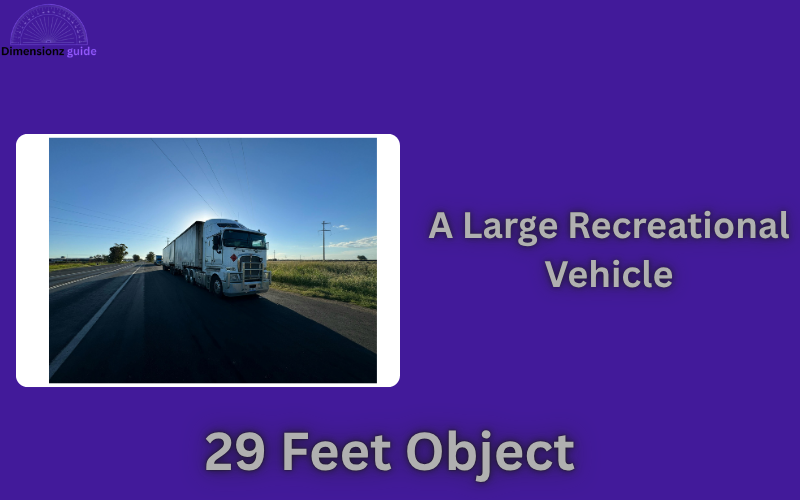
Some large recreational vehicles, commonly called RVs, are around 29 feet long. These vehicles provide living space for people who enjoy road trips, camping, and extended travel. Their length can include the driver’s cabin, living area, kitchen, bathroom, and sleeping spaces.
Visualizing an RV that is 29 feet long gives you a useful reference for understanding this measurement. If you stand near the front bumper and look toward the rear, the full vehicle stretches across a considerable distance. The exact length depends on the RV model and whether its listed measurement includes additional bodywork or attachments.
This comparison is particularly useful when planning a parking space, driveway, or campsite. A space that measures exactly 29 feet may not provide enough room for an RV of the same listed length because additional clearance is often needed at the front and rear.
2. A Small Recreational Sailboat

Some small recreational sailboats measure close to 29 feet from bow to stern. These boats are designed for sailing on lakes, coastal waters, and other suitable waterways. Their length provides room for seating, equipment storage, and, in some models, a compact cabin.
A sailboat of this size makes it easier to imagine how far 29 feet extends. The bow is the front of the boat, while the stern is the back. Measuring between these two ends gives a length that can approach the distance discussed in this guide.
Sailboats vary widely in size, so not every small recreational boat will measure 29 feet. However, a model in this range is a useful example when comparing large recreational equipment. This reference can also help when estimating storage requirements or understanding the space needed in a suitable marina berth.
3. A Long Backyard Swimming Pool

A long backyard swimming pool can measure approximately 29 feet from one end to the other. Residential pools come in many shapes and sizes, and some designs are built to fit longer gardens or outdoor entertainment areas.
Imagine standing at one end of a pool and looking directly across its length to the opposite end. If the pool measures around 29 feet long, the distance would be close to 8.84 meters. Its width would be a separate measurement, so a pool measuring 29 feet long could still be relatively narrow or quite wide.
This example is helpful when planning a backyard renovation or deciding where an outdoor seating area might fit. Remember that the space required for a pool is usually larger than the pool itself. Surrounding decking, walking paths, fencing, and equipment may all need extra room.
4. A Garden Greenhouse

A large garden greenhouse may measure around 29 feet in length. Greenhouses provide a protected environment for growing vegetables, flowers, seedlings, and other plants. Longer models can include several rows of growing space and room for walking paths between them.
Picture a greenhouse with a frame extending almost 30 feet from one end to the other. The length may accommodate plant benches, shelves, containers, or planting beds arranged in sections. Its actual usable space depends on the design, frame thickness, and how the interior is organized.
A greenhouse is a helpful comparison because it is a structure people can walk through and experience from the inside. If you are planning a garden, understanding a 29-foot length can help you estimate how much ground space a long greenhouse might occupy.
Before purchasing one, check the manufacturer’s stated dimensions and make sure the chosen location has enough clearance for access, ventilation, and maintenance.
5. An Outdoor Pergola

A large outdoor pergola can be designed with a length close to 29 feet. Pergolas are garden structures made with posts and an open roof framework. They are commonly placed over patios, outdoor dining spaces, walkways, and seating areas.
Imagine a pergola stretching along the edge of a garden or across a large patio. Its supporting posts may be spaced at intervals along the structure, while beams run overhead to create a shaded architectural feature. A pergola around 29 feet long would cover a substantial outdoor area.
This comparison is useful when considering landscaping or designing an outdoor entertainment space. A structure of this length could accommodate several seating arrangements, depending on its width and layout.
However, pergolas are not all built to standard dimensions. Some are much shorter, while custom structures may be longer. The overall length should be checked against the available space before installation.
6. A Long Utility Trailer
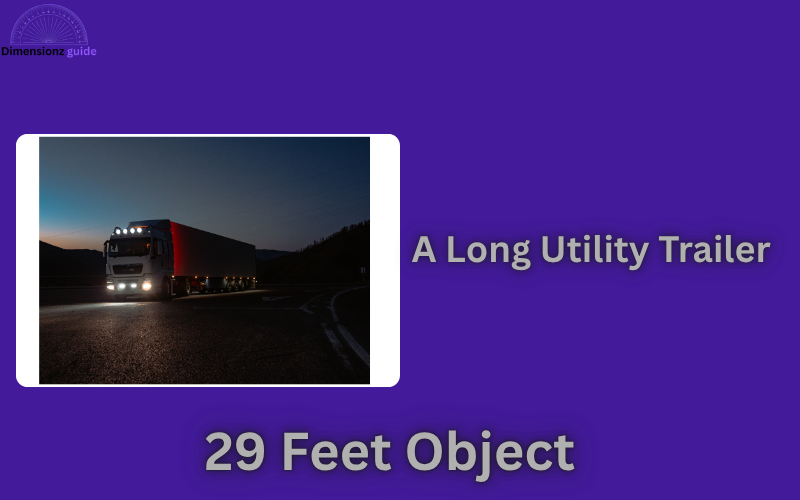
Some utility trailers can measure approximately 29 feet in overall length, especially larger models designed for specialized hauling. These trailers are used to transport equipment, materials, vehicles, or other loads, depending on their construction and intended purpose.
A trailer provides a clear visual reference because its long frame runs in a straight line from front to back. However, it is important to distinguish between the length of the cargo platform and the total length of the trailer. The hitch or tongue can add considerable length beyond the main platform.
If you are comparing a trailer with a 29-foot measurement, check whether the specification refers to the deck alone or the complete trailer. This difference matters when calculating storage space, checking garage or driveway clearance, and planning transportation.
A trailer of this size can take up much more room than a typical passenger vehicle, so a suitable parking or storage area should allow extra space for maneuvering.
7. A Long Outdoor Dining Table Arrangement
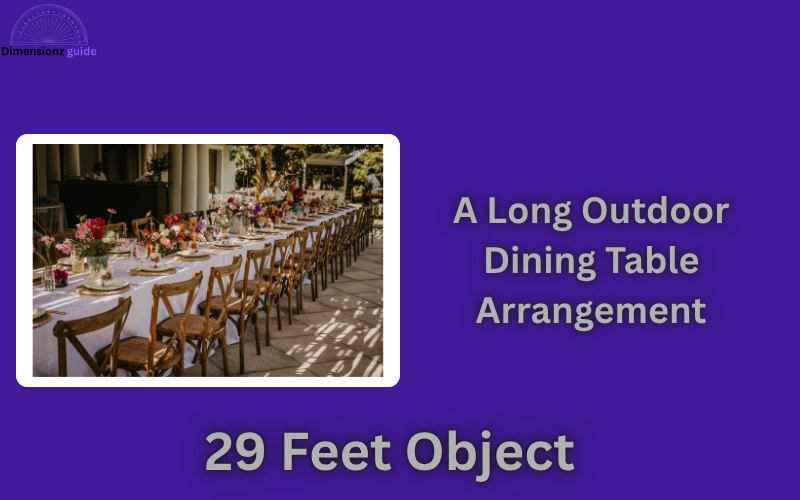
A long outdoor dining arrangement can extend close to 29 feet when several tables are placed end to end. This is not the usual length of a single household dining table; rather, it is a practical example of how a familiar item can form a much longer continuous line.
For example, imagine arranging several event tables in a straight row at a family gathering, outdoor celebration, or community event. Each table contributes to the total length, and the complete arrangement can approach 29 feet depending on the size and number of tables used.
This comparison helps make the measurement more relatable because many people have seen rows of tables at parties, weddings, school events, or outdoor meals. You can imagine walking alongside the entire row to understand how far 29 feet stretches.
When arranging tables, remember that chairs and walking space require additional room. A 29-foot table arrangement does not mean that the entire dining area will fit within a 29-foot-long space.
8. A Long Garden Fence Section
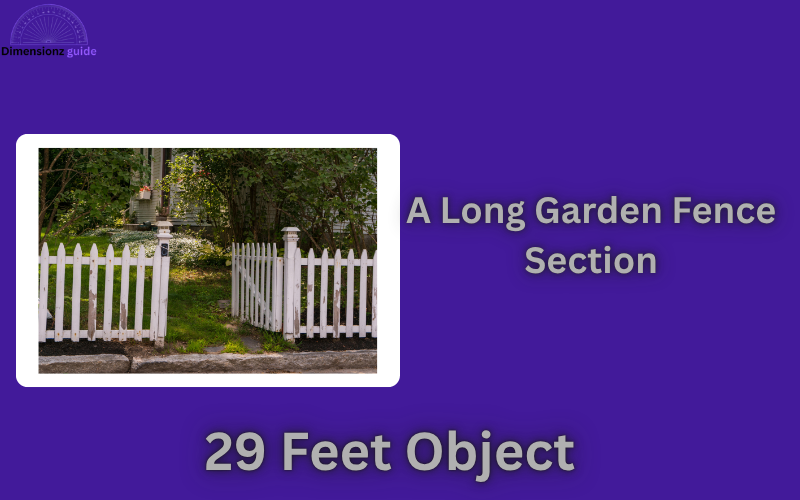
A garden fence section or a connected run of fencing can extend approximately 29 feet along the boundary of a property. Fences are commonly used to separate gardens, protect plants, mark property boundaries, and create privacy around outdoor spaces.
Imagine measuring a straight section of fence from one end post to another point nearly 30 feet away. The total length may consist of several panels joined together, rather than one single panel. The number of panels needed depends on their individual widths and the spacing between posts.
A fence is an especially useful comparison for people planning landscaping projects. Understanding the length can help estimate the number of fence panels required, although gates, corners, and uneven ground can affect the final measurements.
For accurate planning, measure the actual boundary rather than relying only on a visual estimate. Even a small difference can affect the amount of fencing material needed.
9. A Large Event Canopy

A large event canopy may measure around 29 feet along one side. Canopies are temporary or semi-permanent covered structures used at outdoor markets, family celebrations, sporting events, and community gatherings.
A canopy of this size can create a sizable sheltered area, depending on its width. Its frame supports a fabric or other covering, providing shade or some protection from light weather. The actual coverage depends on the canopy’s design and whether its advertised dimensions refer to the roof, frame, or ground footprint.
This example makes 29 feet easier to picture because the length is visible along the canopy’s edge. If you have attended an outdoor event, you may have seen large canopies covering rows of tables, equipment, or seating areas.
When choosing a canopy, measure the available ground space and account for stakes, support legs, ropes, and access routes. The space needed for safe installation may exceed the dimensions of the covered roof.
10. A Long Storage Shed

A large storage shed can be built with a length of approximately 29 feet. Sheds are used to store gardening tools, bicycles, lawn equipment, outdoor furniture, and various household supplies. Larger designs may also provide space for a workshop or dedicated hobby area.
Picture a long rectangular shed with a front entrance and a roof extending over a storage area nearly 30 feet deep or long, depending on its orientation. This can help you imagine the amount of space covered by a 29-foot measurement.
A shed of this length is much larger than many small garden storage units. It may require a suitable foundation, adequate drainage, and enough clearance around the structure for installation and maintenance.
If you are planning to purchase or build a shed, confirm both its external and internal dimensions. Wall thickness, roof overhangs, and door placement can affect how much usable storage space is available.
How to Measure 29 Feet Without a Measuring Tape
If you do not have a measuring tape nearby, you can still estimate 29 feet by using a known reference or dividing the distance into smaller sections. These methods are useful for rough estimates, but they should not replace proper measurement when accuracy is important.
One approach is to use a measuring tool that shows feet or meters. If you have a shorter ruler or tape, mark repeated sections and add them together. For instance, you could measure several smaller lengths and calculate their combined total until they reach 29 feet.
You can also use a familiar object with a known length as a reference. However, do not assume every car, table, or recreational vehicle has the same dimensions. Use the actual specifications of the object whenever possible.
Another option is to convert 29 feet into meters. Since 29 feet is approximately 8.84 meters, a metric tape measure can be used to measure a distance of about 8.84 meters. For construction, property boundaries, or equipment installation, use a suitable measuring tool and verify the result.
Why Understanding 29 Feet Is Useful
Knowing what 29 feet looks like can help in many everyday situations. It is a useful measurement when estimating outdoor structures, checking parking space, comparing recreational equipment, or planning garden layouts.
For example, someone buying a large RV may need to check whether a driveway has sufficient length. A homeowner planning a greenhouse or shed may need to confirm that the structure will fit within the available garden space. Event organizers may also need to understand the length of a canopy or a row of tables before arranging a venue.
Understanding the equivalent measurement in meters can make these tasks easier when using metric plans or products. The conversion is particularly useful when specifications use different units.
Still, visual comparisons should be treated as estimates. If a project depends on exact dimensions, measure the available area directly and leave appropriate clearance.
If you find this helpful and want more free guides like this then here we have more for you:
- 9 Common Everyday Things That Are About 28 Feet Long
- 10 Common Everyday Things That Are About 27 Feet Long
- 11 Common Everyday Things That Are About 26 Feet Long
- 9 Common Everyday Things That Are About 25 Feet Long
- 10 Common Everyday Things That Are About 24 Feet Long
FAQs
Is 29 feet longer than 25 feet?
Yes. 29 feet is 4 feet longer than 25 feet. That difference equals 48 inches, or approximately 1.22 meters.
How many inches are in 29 feet?
There are 348 inches in 29 feet because each foot contains 12 inches. Multiplying 29 by 12 gives 348 inches.
How many meters is 29 feet?
29 feet is approximately 8.84 meters. This conversion is useful when comparing dimensions with metric measurements.
Is 29 feet close to 30 feet?
Yes. 29 feet is just 1 foot shorter than 30 feet. That difference is equal to 12 inches or approximately 30.48 centimeters.
Can a vehicle be 29 feet long?
Yes. Some large recreational vehicles and specialized vehicles can be close to 29 feet long. The exact length depends on the model and its specifications.
Why should I compare 29 feet with everyday objects?
Everyday comparisons make an unfamiliar measurement easier to visualize. Large objects and outdoor structures can help you estimate how much space a length of 29 feet occupies, but exact dimensions should always be verified when needed.
Related Post: 10 Common Everyday Things That Are About 27 Feet Long
Conclusion
So, how long is 29 feet? It is equal to 348 inches, approximately 8.84 meters, or about 9.67 yards. Although the measurement may be difficult to imagine on its own, comparing it with a large RV, recreational sailboat, swimming pool, greenhouse, pergola, utility trailer, or storage shed makes the length easier to understand.
These examples provide practical ways to visualize 29 feet when planning a garden, checking available space, or comparing large objects. Remember that the dimensions of real-world items vary, so use verified measurements whenever precision matters.