
Introduction
Cinema has always been a powerful combination of visuals, storytelling, and sound. While stunning cinematography captures attention, sound creates the emotional atmosphere that brings a story to life. Today, spatial audio is revolutionizing how audiences experience movies by transforming traditional soundtracks into immersive, three-dimensional environments.
From subtle footsteps behind a character to thunder rolling across an entire theater, spatial audio allows viewers to experience sound as though they are physically present within the scene. This technological advancement is changing filmmaking techniques, audience expectations, and the future of cinematic entertainment.
Understanding Spatial Audio in Modern Cinema
Spatial audio is an advanced sound technology that places audio elements within a three-dimensional environment. Unlike conventional stereo systems, which primarily distribute sound between left and right channels, spatial audio creates the impression that sound originates from specific locations around the listener.
This technology uses sophisticated audio processing, multiple speaker configurations, and sometimes personalized headphone rendering to simulate realistic sound movement.
For example, when a helicopter flies across the screen, spatial audio can make its sound appear to travel overhead rather than simply shifting between speakers.
Technologies such as Dolby Atmos, DTS:X, and other immersive audio formats have helped expand the possibilities of cinematic sound design.
The Evolution from Traditional Surround Sound
Traditional surround sound introduced audiences to a more engaging listening experience by distributing audio across multiple speakers. Systems such as 5.1 and 7.1 surround sound became widely used in movie theaters and home entertainment setups.
However, these systems typically assign sounds to specific channels.
Spatial audio introduces a different approach through object-based sound technology. Instead of permanently attaching every sound to a particular speaker, filmmakers can position individual audio objects within a virtual three-dimensional space.
Compatible playback systems then determine how those sounds should be reproduced using the available speakers.
This flexibility gives sound designers greater creative control while making immersive audio adaptable to different theater configurations.
Creating More Realistic Cinematic Environments
One of the greatest advantages of spatial audio is its ability to create believable environments.
Imagine watching a film set in a dense rainforest. Traditional audio might reproduce birdsong, rainfall, and rustling leaves through surrounding speakers. Spatial audio can provide a more detailed experience by positioning individual sounds at different distances and heights.
A bird may appear to call from above, while footsteps approach from behind and rainfall surrounds the audience.
These subtle acoustic details help viewers understand the environment without relying entirely on visual information.
As a result, filmmakers can create stronger connections between audiences and fictional worlds.
Enhancing Emotional Storytelling Through Sound
Sound does more than reproduce environmental effects. It influences emotions, builds suspense, and guides audience attention.
Spatial audio provides filmmakers with new opportunities to communicate emotional meaning.
In a suspenseful scene, a faint sound behind the audience may create uncertainty before the source becomes visible. In a dramatic moment, distant echoes and carefully positioned ambient sounds can emphasize loneliness or emotional isolation.
Action sequences also benefit from immersive sound placement. Explosions, moving vehicles, and shifting environmental effects can create a convincing sense of scale and movement.
By controlling where sounds appear and how they move, filmmakers can strengthen storytelling without adding unnecessary dialogue or visual effects.
The Growing Importance of Sound Designers
As spatial audio becomes more common, sound designers are taking on increasingly creative roles in film production.
Their responsibilities now extend beyond recording dialogue, creating effects, and mixing background audio.
Modern sound professionals must consider three-dimensional positioning, acoustic depth, sound movement, and how audio interacts with the visual environment.
They also collaborate closely with directors, editors, composers, and visual effects teams to ensure that immersive sound supports the narrative.
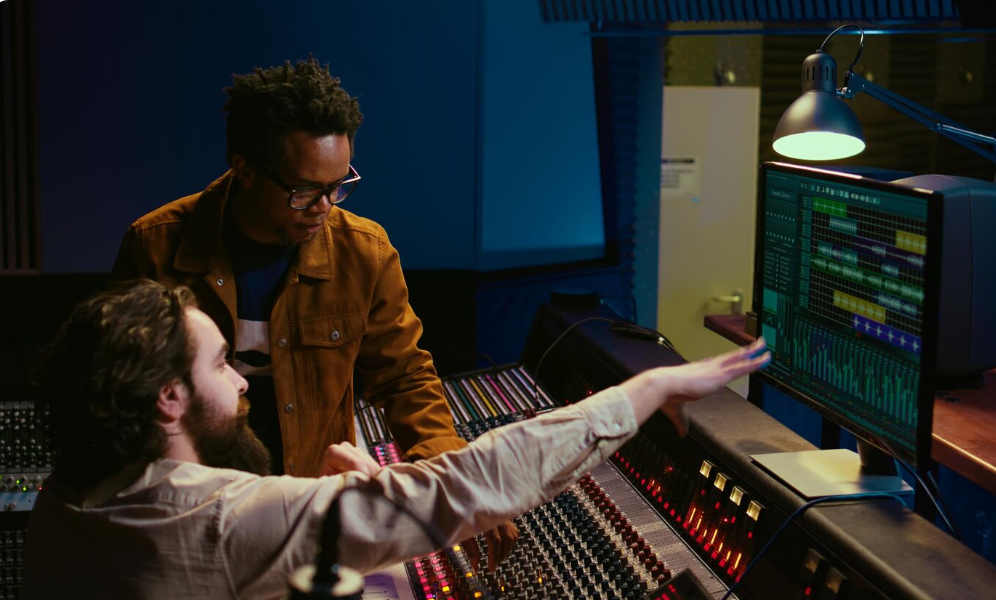
Advanced digital audio workstations and object-based mixing tools allow sound designers to experiment with complex soundscapes while maintaining dialogue clarity.
This combination of artistic creativity and technological expertise is redefining sound production.
Bringing the Cinema Experience into Homes
Spatial audio is no longer limited to premium movie theaters.
Modern soundbars, wireless speaker systems, headphones, and compatible streaming platforms increasingly support immersive audio formats.
Some devices use head-tracking technology to adjust the perceived direction of sound as listeners move their heads.
This creates a more stable virtual sound environment, particularly when watching films through compatible headphones.
Although the experience depends on equipment, room acoustics, and content quality, spatial audio is helping narrow the gap between theatrical sound and home entertainment.
Challenges Facing Spatial Audio Adoption
Despite its advantages, spatial audio presents several challenges.
Creating high-quality immersive soundtracks requires specialized equipment, professional expertise, and additional production resources.
Movie theaters may need upgraded speakers and audio-processing systems, while home viewers require compatible playback devices.
Another challenge involves consistency. A soundtrack mixed for a large theater may sound different when reproduced through headphones or a compact soundbar.
Sound designers must therefore carefully balance creative ambition with practical playback requirements.
Accessibility and affordability will also influence how widely immersive audio technologies are adopted.
The Future of Spatial Audio in Filmmaking
The future of cinematic sound will likely involve increasingly intelligent and adaptable audio systems.
Artificial intelligence may assist sound professionals with audio separation, environmental modeling, and efficient sound placement. Meanwhile, improvements in personalized audio rendering could make immersive experiences more convincing across different listening devices.
Virtual reality and mixed-reality entertainment may further expand the role of spatial sound, especially in experiences where audiences can freely explore digital environments.
However, technology alone cannot guarantee compelling storytelling. Effective spatial audio depends on thoughtful creative decisions that support the film rather than distract from it.
Conclusion
Spatial audio represents a major evolution in cinematic sound design. By introducing realistic three-dimensional sound placement, it allows filmmakers to create immersive environments, strengthen emotional storytelling, and expand the creative possibilities of audio production.
As immersive sound technology becomes more accessible, audiences can expect richer and more engaging movie experiences both in theaters and at home.
Ultimately, the sound design revolution is not simply about hearing more sounds. It is about experiencing cinema in a deeper, more meaningful way.
Read More : Avant-Garde Utility: The Fusion of High Fashion and Extreme Technical Gear
Do you like this personality?