
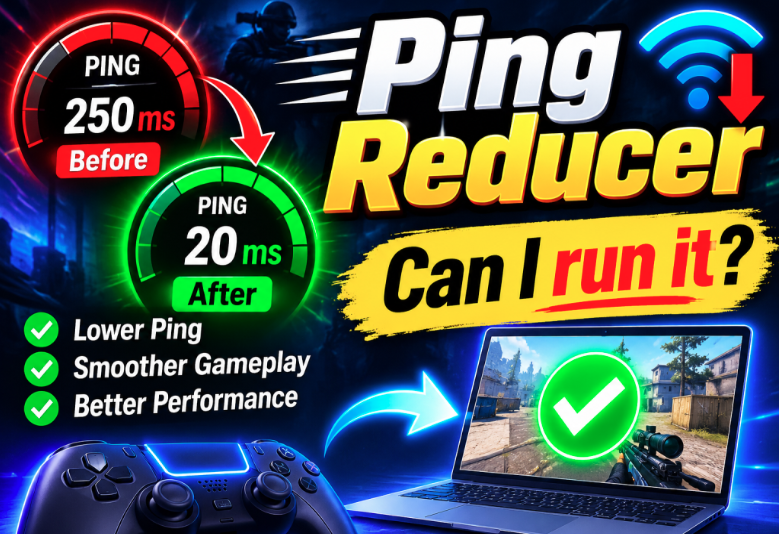
Online gaming has become increasingly popular, with millions of players enjoying competitive matches, multiplayer adventures, and demanding PC games. However, a good gaming experience depends on more than having an interesting game. Players also need a stable internet connection and a computer capable of handling the game’s requirements. High ping, connection delays, low frame rates, and hardware limitations can affect gameplay and create unnecessary frustration.
Two important topics every PC gamer should understand are Ping Reducer and Can I run it. A Ping Reducer focuses on improving network responsiveness, while Can I run it helps users determine whether their computers meet the requirements of particular games. Understanding both can help players identify technical problems and make better decisions before starting a new gaming experience.
How Does a Ping Reducer Operate?
Ping calculates the time it takes for information to travel from a player’s PC to a gaming server and back. It is usually measured in milliseconds (ms). Lower ping generally means faster communication with the server, which is particularly important in competitive online games.
A Ping Reducer is a software tool or network optimization solution designed to help improve connection responsiveness. Depending on its technology, it may optimize network routing, manage traffic, or help users connect through more efficient routes.
For example, a player experiencing delays in an online shooting game might find that their actions take longer to register. A network optimization tool may help when inefficient routing or certain network conditions contribute to the problem.
However, a Ping Reducer cannot guarantee lower latency in every situation. Internet service quality, server distance, network congestion, and routing conditions all influence ping.
Common Reasons Behind High Ping
Before choosing a Ping Reducer, gamers should understand what causes connection delays.
1. Distant Game Servers: Connecting to a server located in another country can increase the time required for data to travel between devices.
2. Unstable Wi-Fi: Weak wireless signals, physical obstacles, and interference from nearby networks can create inconsistent connections.
3. Network Congestion: When several devices stream videos, download files, or browse the internet simultaneously, available bandwidth may become limited.
4. Background Downloads: Automatic updates and large downloads can compete with gaming traffic and contribute to connection problems.
5. ISP Routing: Sometimes, an internet provider uses a less efficient route to reach a particular game server, increasing latency.
Identifying the actual cause is important because different connection problems require different solutions.
How a Ping Reducer Can Improve the Gaming Experience
A reliable Ping Reducer can help address certain network-related problems by optimizing how gaming traffic reaches its destination.
Some network optimization applications offer features such as alternative routing, connection monitoring, and traffic management. These options may help users achieve more consistent connections when their default network route is inefficient.
For competitive gamers, stable ping is often more important than simply having a high internet speed. A fast internet package does not automatically guarantee low latency because bandwidth and ping measure different aspects of network performance.
Players should also consider using an Ethernet cable, selecting nearby servers, and pausing unnecessary downloads while gaming.
Can I Run It? Why Every Gamer Should Check PC Compatibility
Before downloading a new game, many players ask an important question: Can I run it?
This question helps users determine whether their computers have enough processing power, memory, graphics capability, and storage to handle a particular title.
Modern PC games have different hardware requirements. Some lightweight games work well on basic computers, while advanced games may require dedicated graphics cards and powerful processors.
Checking compatibility before installation can prevent wasted time, storage space, and internet data.
Most developers provide two categories of system requirements:
- Minimum requirements: The basic specifications needed to launch and run a game, potentially with reduced graphics settings.
- Recommended requirements: The specifications intended to provide a smoother experience and better visual quality.
A computer meeting only the minimum requirements may still experience performance limitations, depending on the game and its settings.
How to Check Whether Your PC Can Run a Game
Finding out whether a computer meets a game’s requirements does not have to be difficult. Users can follow a few simple steps.
Step 1: Check Your Computer Specifications
Start by identifying your processor, graphics card, RAM, operating system, and available storage. Windows Task Manager and System Information can help users find many of these details.
Step 2: Find the Game’s Requirements
Visit the game’s official website or store page and locate its minimum and recommended system specifications.
Step 3: Compare Your Hardware
Compare your computer’s components with the published requirements. Pay particular attention to the CPU and GPU because they strongly influence game performance.
Step 4: Use a Compatibility Checker
A game compatibility checking tool can simplify the process by comparing available hardware information with a game’s requirements.
Step 5: Adjust Your Expectations
If your computer meets the minimum requirements, consider starting with lower graphics settings. If it meets the recommended specifications, you may have more options for improving visual quality.
What Hardware Matters Most for Gaming?
Understanding individual hardware components makes it easier to answer the question, Can I run it?
Processor (CPU): The processor handles calculations, game logic, artificial intelligence, and background operations. A weaker CPU can limit performance in demanding games.
Graphics Card (GPU): The graphics card renders images, textures, lighting, and visual effects. Games with advanced graphics often require more powerful GPUs.
RAM: System memory allows games to access information quickly. Insufficient RAM can contribute to stuttering and slow performance.
Storage: Modern games can occupy considerable disk space. An SSD generally provides faster loading times than a traditional hard drive.
Operating System: Some games require particular Windows versions or software components to function correctly.
Checking these specifications before purchasing or downloading a game can help avoid compatibility problems.
Can a Ping Reducer and PC Compatibility Checker Work Together?
Although these tools address different problems, they can complement each other.
A Ping Reducer focuses on network responsiveness, while Can I run it focuses on hardware compatibility. One helps users understand whether their internet connection is suitable for online gaming, and the other helps determine whether their computer can handle a specific game.
For example, a computer may meet all the recommended hardware requirements but still experience online lag because of an unstable internet connection. Similarly, a player may have excellent ping but experience low frame rates because their graphics card is underpowered.
Understanding both areas helps gamers identify whether a problem comes from their computer or their network.
Practical Tips for a Better Gaming Experience
Players can improve their overall gaming environment by following these simple recommendations:
- Use a wired Ethernet connection whenever possible.
- Choose geographically closer game servers.
- Close unnecessary background applications.
- Keep graphics drivers updated.
- Monitor CPU and GPU temperatures.
- Pause large downloads during online matches.
- Adjust graphics settings according to available hardware.
- Maintain sufficient free storage space.
These habits can help reduce avoidable problems and support more consistent gameplay.
Conclusion
Enjoying online games requires a balance between computer performance and network quality. A Ping Reducer can help address certain connection-related problems, while Can I run it tools allow gamers to check hardware compatibility before installing demanding titles.
Understanding the difference between network latency and PC performance makes troubleshooting much easier. By checking system requirements, maintaining updated drivers, selecting suitable servers, and using a stable internet connection, players can make better use of their existing computers.
Ultimately, identifying the real cause of gaming problems is the first step toward a smoother and more enjoyable experience.